Warning: file_exists(): open_basedir restriction in effect. File(/var/www/vhosts/cescols.com/httpdocs/wp-content/plugins/wp-rocket/) is not within the allowed path(s): (/var/lib/php:/var/www/vhosts/cescols.com/httpdocs:/tmp:/var/lib/php/session:/usr/bin/php:/usr/share/php:/usr/share/pear:/usr/share/phpMyAdmin:/etc/phpMyAdmin:/usr/share/doc:/var/lib/phpMyAdmin:/var/www/vhosts/cescols.com/httpdocs/iwin_copy:/var/www/vhosts/cescols.com/httpdocs_newsite:/var/www/vhosts/cescols.com/httpdocs_dev:/var/www/vhosts/cescols.com/httpdocs_suite8:/var/www/vhosts/cescols.com/httpdocs_drupal:/var/www/vhosts/cescols.com/httpdocs_suite81:/var/www/vhosts/cescols.com/httpdocs_iwntst:/var/www/vhosts/cescols.com/httpdocs_iwindev:/var/www/vhosts/cescols.com/httpdocs_ispeak:/var/www/vhosts/cescols.com/httpdocs_stagingwin:/var/www/vhosts/cescols.com/httpdocs_stagingwin/vendor:/var/www/vhosts/cescols.com/httpdocs_suite88) in /var/www/vhosts/cescols.com/httpdocs_newsite/wp-content/advanced-cache.php on line 17
Why Confidential Legal Translation Is Essential for Attorneys
  1. Home
  2. /
  3. Blog
  4. /
  5. Translation Services
  6. /
  7. Why Confidentiality in Legal...

Why Confidentiality in Legal Translation Is a Must-Have for Attorneys? 

As an attorney, how certain are you that your chosen legal translation services rigorously protect your clients' sensitive information?
Why Confidentiality in Legal Translation Is a Must-Have for Attorneys?

Table of Contents

Trust and discretion form the bedrock of your legal practice. Clients entrust you not only with their legal challenges but also with highly personal and confidential data. This responsibility extends critically to the handling of translated documents.

When dealing with legal translation, particularly in sensitive areas like immigration law, confidentiality isn’t merely a best practice—it’s an absolute imperative. 

Let’s explore why embedding strict confidentiality into your legal translation workflow is crucial for safeguarding your clients’ futures and upholding the integrity of your practice. 

The Stakes Are High 

Attorneys routinely handle documents brimming with sensitive data – from legal contracts and personal affidavits to court records and immigration applications. These documents often contain intimate details about a client’s past, present circumstances, and legal status.

Should any fragment of this information be compromised, the consequences can be devastating, potentially jeopardizing not only the legal matter at hand but also the client’s safety and future prospects. 

The inherent risks associated with digital communications further compound these challenges. As highlighted in reports by Lawyers for Lawyers, the digitalization of legal practice introduces vulnerabilities.

Unauthorized access to emails, video conferences, or digital documents can compromise legally privileged communications and client confidentiality.  

Such breaches erode client trust and can severely damage your professional reputation, especially when managing multilingual cases that demand the utmost discretion, such as those in immigration law. The digital landscape, the report underscores, necessitates vigilant safeguarding of client data to maintain professional standards and trust. 

Confidentiality breaches are far more than simple mistakes 

A failure to maintain confidentiality transcends mere embarrassment; it can carry significant legal and ethical implications. Neglecting to adequately protect client information could lead to violations of data privacy regulations, such as the General Data Protection Regulation (GDPR), or breaches of fundamental legal principles, such as the attorney-client privilege in the U.S. 

Such lapses can result in severe repercussions, including malpractice lawsuits, disciplinary actions, potential disbarment, and lasting damage to your professional standing. As Lawyer Monthly notes, the complexity of legal translation means even minor oversights can lead to significant misunderstandings or critical breaches of trust.

This is particularly pertinent when working with multilingual clients who may already feel vulnerable navigating an unfamiliar legal system; any perceived compromise of their privacy can irrevocably damage the attorney-client relationship. 

Why Certified Translators Matter 

While the allure of cheaper or faster translation options exists, compromising on quality and security can incur far greater costs in the long run.

Professional legal translators, especially those affiliated with reputable agencies like Cesco Linguistic Services, possess a deep understanding of both legal nuances and the critical importance of confidentiality. 

Crucially, professional linguists typically operate under stringent non-disclosure agreements (NDAs), legally binding them to protect client data. Furthermore, established Language Service Providers (LSPs) use secure technologies, including encrypted communication channels and file transfer protocols, to ensure sensitive documents remain protected from unauthorized access throughout the translation process. 

The Consequences of Not Prioritizing Confidentiality 

Make no mistake: failing to prioritize confidentiality places both your clients and your practice at significant risk. Research from Cornell Law indicates that translation errors and confidentiality breaches can severely disrupt legal proceedings, potentially leading to adverse outcomes, including case dismissal.  

A poorly handled or inaccurately translated document can create critical misunderstandings, cause costly delays, or even expose your client to further legal or personal jeopardy. 

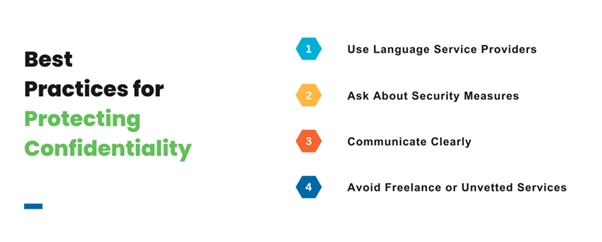
Best Practices for Protecting Confidentiality 

How do you ensure confidentiality is never compromised? Here are a few tips: 

Best Practices for Protecting Confidentiality
  1. Use Language Service Providers: Engage professional translation agencies with proven expertise in legal translation and demonstrable commitments to confidentiality. 
  2. Ask About Security Measures: Inquire about the specific security measures the LSP employs. Do they utilize end-to-end encryption? Are NDAs standard procedure for all translators and staff? How is data stored and eventually destroyed? 
  3. Communicate Clearly: Explicitly communicate the sensitive nature of the documents and your stringent confidentiality requirements to your translation provider. 
  4. Avoid Freelance or Unvetted Services: Unvetted freelance platforms or services cannot guarantee robust security measures or specialized legal expertise, particularly for complex immigration matters. 
 

How Much Risk Are You Willing to Accept? 

Client confidentiality is not an area where compromise is acceptable.

By partnering with trusted, security-conscious linguistic service providers like Cesco Linguistic Services, you actively safeguard client privacy, meet your ethical and legal obligations, and protect the reputation you’ve worked diligently to build. 

Is your legal practice adequately prioritizing confidentiality in every aspect of its operations, including translation? 

Remember, in the legal profession, trust is paramount. Don’t let a preventable breach undermine your practice and your clients’ futures. 

Like what you read? Share it with your Friends.

Cesco Linguistic Services
About Us

Cesco Linguistic Services was founded on August 4, 2004. Our passion is to facilitate Human-to-Human understanding in meaningful and rewarding ways through the power of language.

Attention Supply Chain Managers!

Unlock the Secrets to Flawless Supply Chain Document Translation

We present you this indispensable Checklist to ensure your translations are accurate, culturally sensitive, and fully compliant with industry standards.

Related Posts

Seize this opportunity

Master Your Global Communications With Cesco​

Are you ready to unlock the full potential of your next big idea?

Contact us today to explore how our skilled linguists convey your message to diverse audiences accurately and naturally.